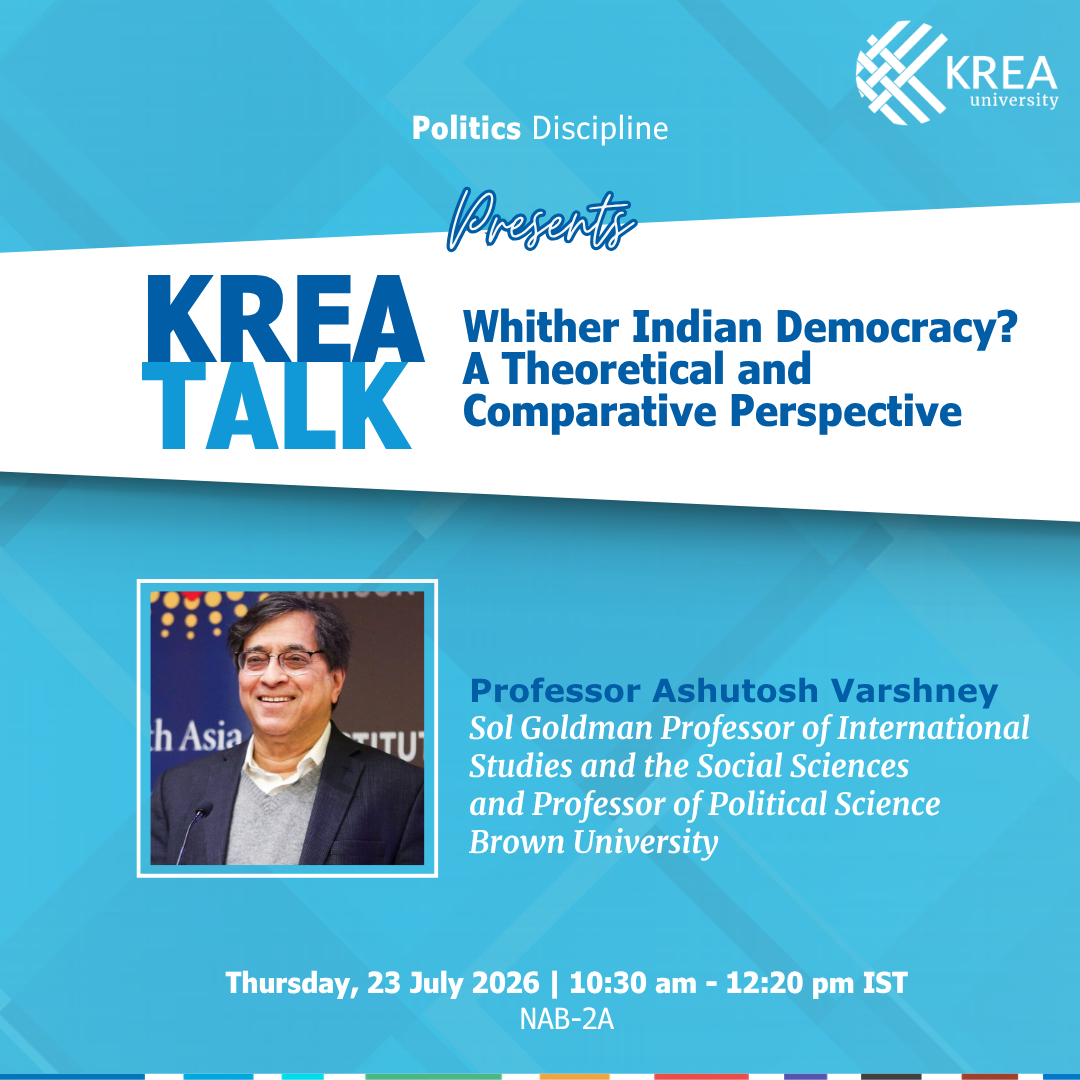
Comparative data has long shown that democracies tend not to last in low-income settings. Sometimes, extreme diversity or deep-rooted inequalities are also argued to be unpropitious conditions for democratic longevity. India has been an exception to these larger cross-country theories, and democracy theorists have long recognised it. Does this "democratic exceptionalism" persist today? Does the concept of "democratic backsliding" hold relevance? This lecture will analyse India’s democratic trajectory through a global, comparative lens, exploring both the sources of its historical resilience and the nature of its deepening fragilities.
|
|
|
|
Ashutosh Varshney is Sol Goldman Professor of International Studies and the Social Sciences and Professor of Political Science at Brown University. Previously, he taught at Harvard and the University of Michigan, Ann Arbor, among others. His books include Battles Half Won: India’s Improbable Democracy, Ethnic Conflict and Civic Life: Hindus and Muslims in India, Collective Violence in Indonesia, India in the Era of Economic Reforms, and Democracy, Development and the Countryside: Urban-Rural Struggles in India. His articles have appeared in professional journals such as World Politics, Perspectives on Politics, Comparative Politics, American Journal of Sociology, Studies in Comparative International Development, World Development, Journal of Development Studies, Journal of Democracy, Journal of Asian Studies, Asian Survey, Journal of East Asian Studies, Daedalus, Foreign Affairs, Economic and Political Weekly, among others. The awards based on his research include the Guggenheim and Carnegie Fellowships, the Gregory Luebbert Prize, and the Daniel Lerner Prize. In addition to professional journals, he also contributes guest columns to newspapers and magazines and is currently a columnist for The Print.
|
|
|
Admin office: 196, T.T.K. Road, Alwarpet, Chennai - 600018
Campus: 5655, Central ExpressWay, Sri City, Andhra Pradesh - 517464
www.krea.edu.in
|
|
|
|
|