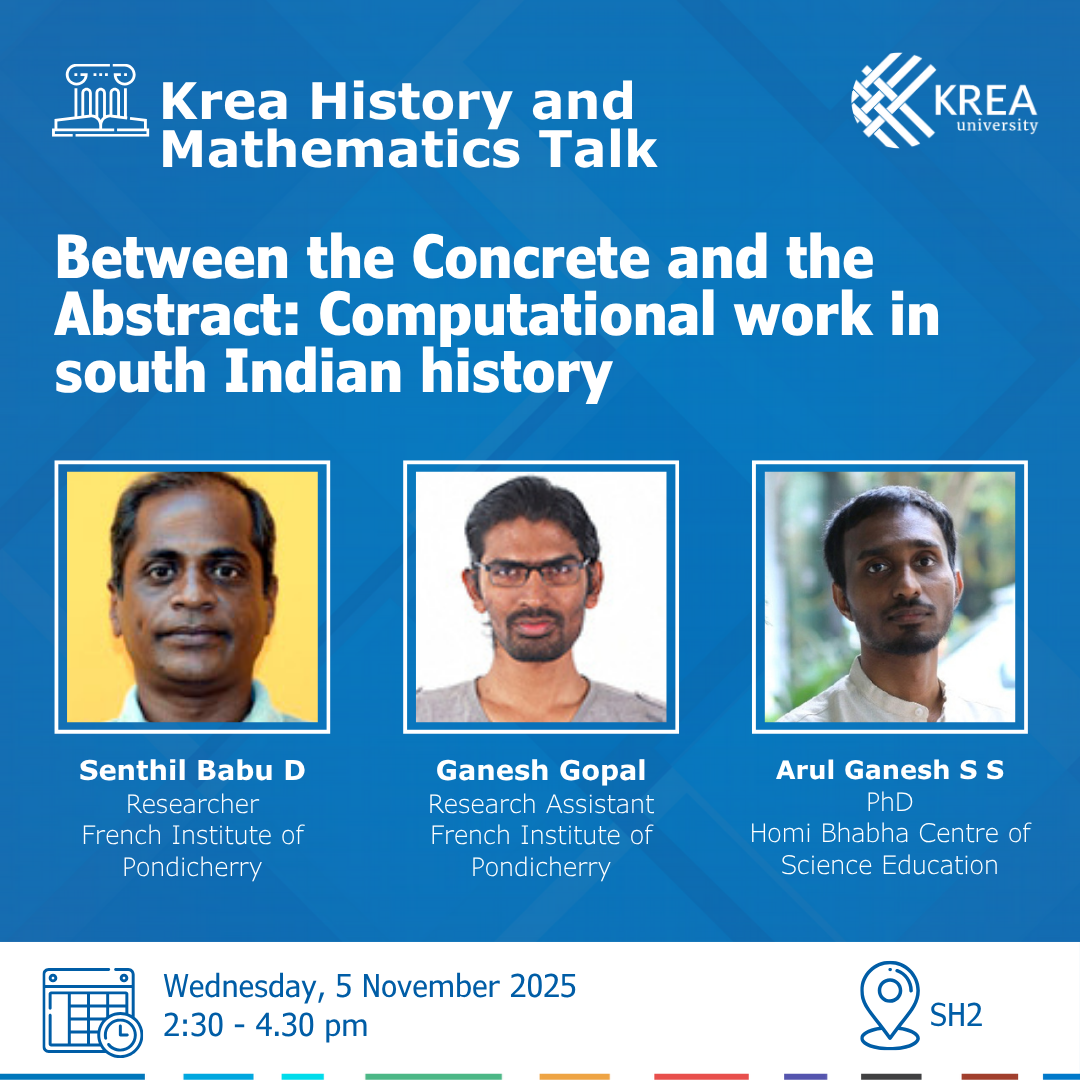
Senthil Babu D, is a historian of mathematics based at the French Institute of Pondicherry, in south India, where he is involved in studies concerning Nature, Knowledge and Labour [https://ifpindia.org/research/social-sciences/knowledge]. His research in the history of science and mathematics is focused on knowledge practices in political economies to understand the relationship between abstraction and alienation in different cultures. The programme in the Social History of mathematical practices subjects computational work to historical scrutiny, through inquiries into texts, practice and practitioners. Practices of measure, calculation and value making, remain central concerns for such a programme. A historical atlas of metrology and an archive of computational practices in south India are part of this initiative: echoes.ifpindia.org. He completed his PhD from the Centre for Historical Studies, Jawaharlal Nehru University in New Delhi. His book, Mathematics and Society: Numbers and Measures in early modern South India, was published by Oxford University Press in 2022. He is a member of the editorial board of the series, Verum Factum: Studies in Political Epistemology [https://verumfactum.it/]. He is a member of the Politically Mathematics Collective in India [https://www.politicallymath.in/]
Ganesh Gopal has trained as Electronics and communication engineer and got his research experience by making the scientific research instruments like spectrophotometer and roughness indexing at CSIR where the opportunity to understand the relationship between measuring using instrument specifically built for understanding a natural phenomena, and use the same to control to shape it into a scalable technology to be used by the public and industry alike. His engagement with civil societies and collectives like State level Science Forum and Free Software Foundation helped him not only gain necessary skills in building such tools in public domain but also largely helped him in sharing the knowledge and the practice to University students and wider public periodically.
Realising the limitations in conventional research and development laboratories in reaching out to public, his engagement with civil societies have largely helped in transitioning his learning from natural sciences to social sciences while providing reasonable answers that he wasn't able to search during his work in nationalised research wings. His work with FOSS, GIS, design. documentation, interest in mathematical modeling (a habituation from CSIR days), and keen interest in organising information entities greatly helped me understand the depth of the research work in reconstructing social history of practices by tooling the historical research by building a contextual archive and historical atlas from related facets and perspectives (of which metrology is fundamental one that relates directly with valuation). His contributions and expressions can be read at: https://cosmobird.github.io/
Arul Ganesh S S, with formal training in mathematics and mathematics education, recently joined the programme in the Social History of Mathematical Practices at the IFP. Arul Ganesh's research interests lie in exploring the relationships between society, mathematical knowledge, and mathematics education, examining how mathematical practices shape institutions and everyday life, and how, in turn, social contexts influence those practices. He is involved in curating the Archive of Mathematical Practices at the IFP, where, along with others, Arul Ganesh seeks to organise and curate materials in a way that reveals these interconnections between mathematical knowledge/school/text, practice/work, and practitioner/society/people, so that the archive may serve pedagogic functions and open new avenues for research.