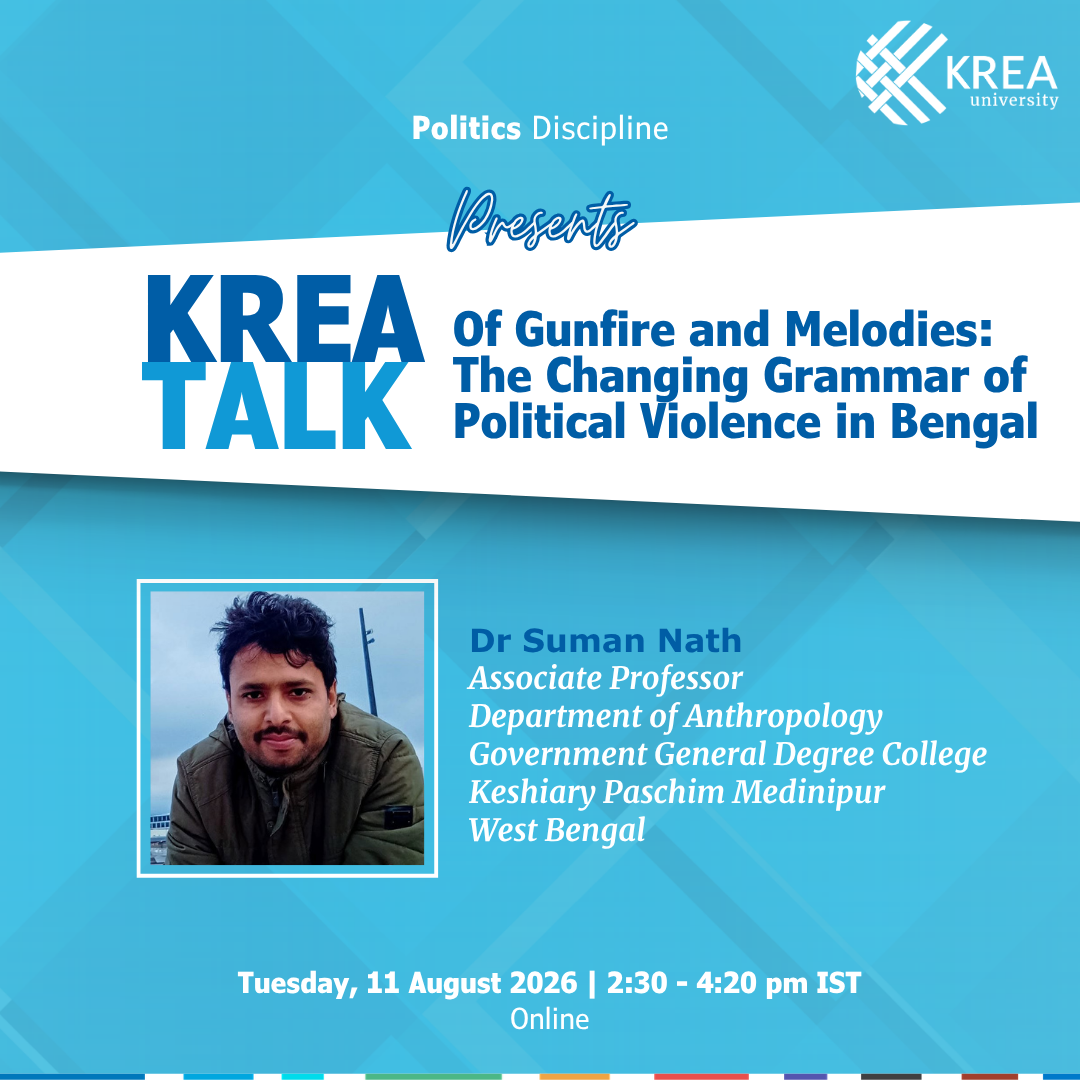
Dr Suman Nath, did his PhD in Anthropology, in collaboration with IIM Calcutta and University of Calcutta. Presently he teaches at the Government General Degree College, Keshiari, West Bengal. Since 2007, he has researched resource politics, communalism, and political violence, with publications in leading international journals. His well-known books include a couple of monographs, People-Party-Policy Interplay in India (2020, Routledge) and Democracy and Social Cleavage in India (2023, Routledge), and an edited volume, Theory, Policy, Practice (2023, Routledge). He has been awarded by UNDP, Planning Commission, and SaciWATERs. Apart from his regular invited talks in various institutions and platforms in India, he has also been invited by several European universities like Gottingen, Norway and Amsterdam, and international forums like the Royal Anthropological Institute, UK. Dr Nath also writes for The Wire, The Print, Outlook, The Indian Express, little magazines, and in Bengali dailies, and runs internationally recognised blogs on study materials and popular pieces. His upcoming book entitled The Scent of Mahua, the Smell of Gunpowder and the Sound of Radicalisation is set to release next year from Routledge, London.
|
|
|
|
West Bengal experiences one of the highest instances of political violence in India. While global studies emphasise the instrumental and institutional backgrounds of political violence, the agents and their activities often remain understudied. Using longitudinal, multisite, immersive ethnographic research spanning nearly two decades, Dr Suman Nath has written several accounts of violence from the perspective of agencies and their activities.
In this talk, based on his upcoming book, The Scent of Mahua, the Smell of Gunpowder and the Sound of Radicalisation, an attempt will be made to map the major trajectories of political violence from the Maoist and counter-forces in Junglemahal during the first decade of the 21st century through the political-economic trajectories during the ruling Trinamool Congress era to the rise of fundamentalist politics during the last ten years. Using his ethnographic data, Dr Nath challenges the binary of “state vs. communal violence”, “pre-election vs. post- election violence” by showing their entanglements. Dr Nath shows that the agency of ordinary people is within the precarious structures of a messy state, marked by inclusive and normalised illegalities. He refuses simple moral judgments on violence and show why violence is a purposive and professional instrument, and unearth the fluidity of perpetrators and victims, which is contextual.
|
|
|
All are welcome; no registration required.
|
Admin office: 196, T.T.K. Road, Alwarpet, Chennai - 600018
Campus: 5655, Central ExpressWay, Sri City, Andhra Pradesh - 517464
www.krea.edu.in
|
|
|
|
|