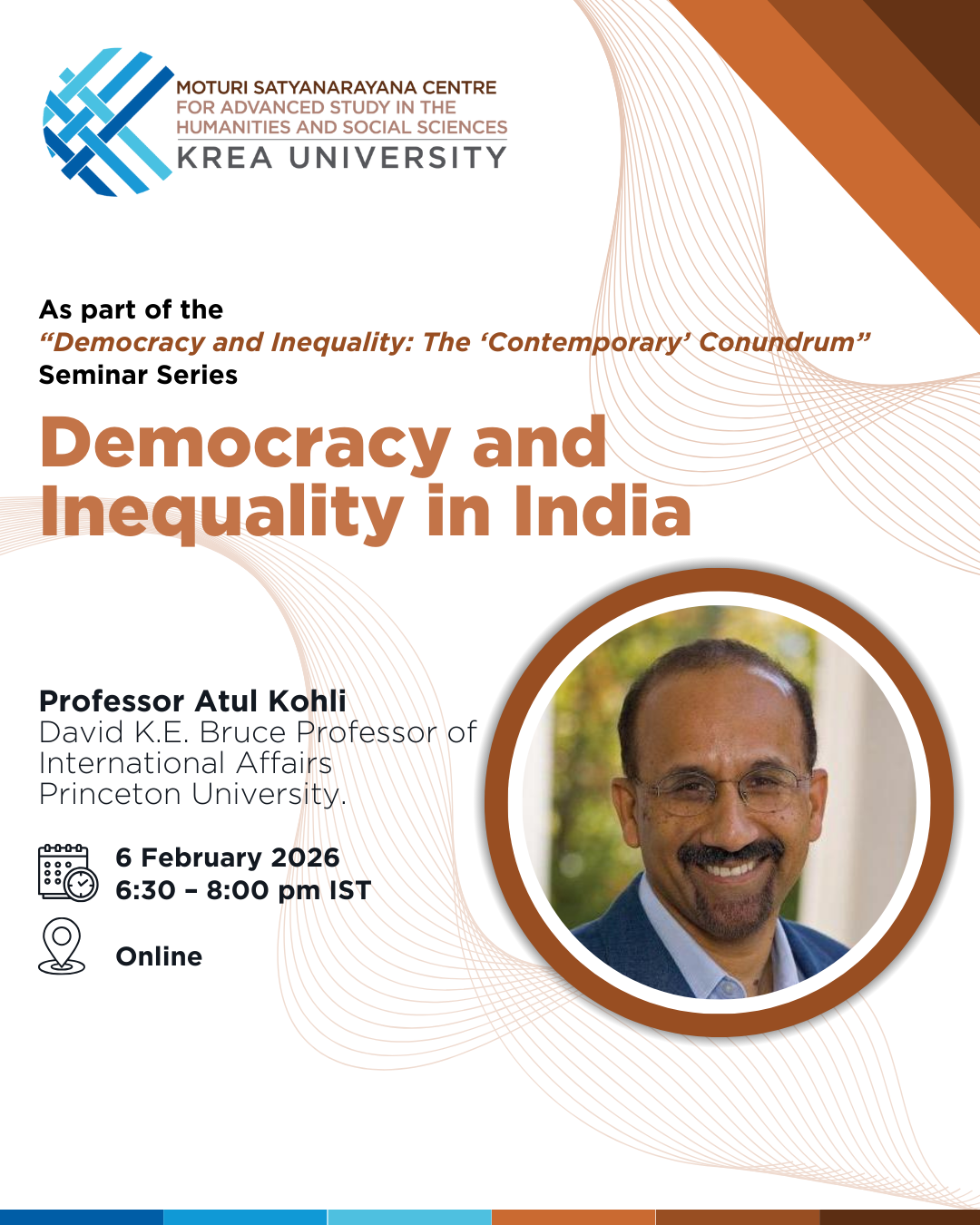
Over the last decade, soaring wealth and income inequalities have had a significant impact on India's democracy. With the continuing mobilisation in the name of religious identity to retain power and dominance and stagnant welfare spending, how do we make sense of the current political predicament in India?
ABOUT THE SPEAKER
Professor Atul Kohli is the David K.E. Bruce Professor of International Affairs at Princeton University. His principal research interests are in the area of political economy of developing countries. He is the author of Democracy and Inequality in India: Political Economy of a Troubled Giant (with Kanta Murali), (Cambridge University Press, 2025); Greed and Guns: Imperial Origins of the Developing World (Cambridge University Press, 2022); Imperialism and the Developing World: How Britain and the U.S. Shaped the Global Periphery (2020); Poverty amid Plenty in the New India (2012) (a Foreign Affairs Best Book of 2012 on Asia and the Pacific); State-Directed Development: Political Power and Industrialization in the Global Periphery (2004) (winner of the Charles Levine Award (2005); Democracy and Discontent: India: Growing Crisis of Governability (1991); and The State and Poverty in India (1987). He has also edited or coedited ten volumes (most recently, Business and Politics in India, 2019; and States in the Developing World, 2017) and published some sixty articles. He served as the chief editor of the journal World Politics during 2006-13 and was the Vice President of the American Political Science Association, 2009-10. He has received grants from the Social Science Research Council, Ford Foundation and the Russell Sage Foundation. He received his PhD from the University of California, Berkeley.