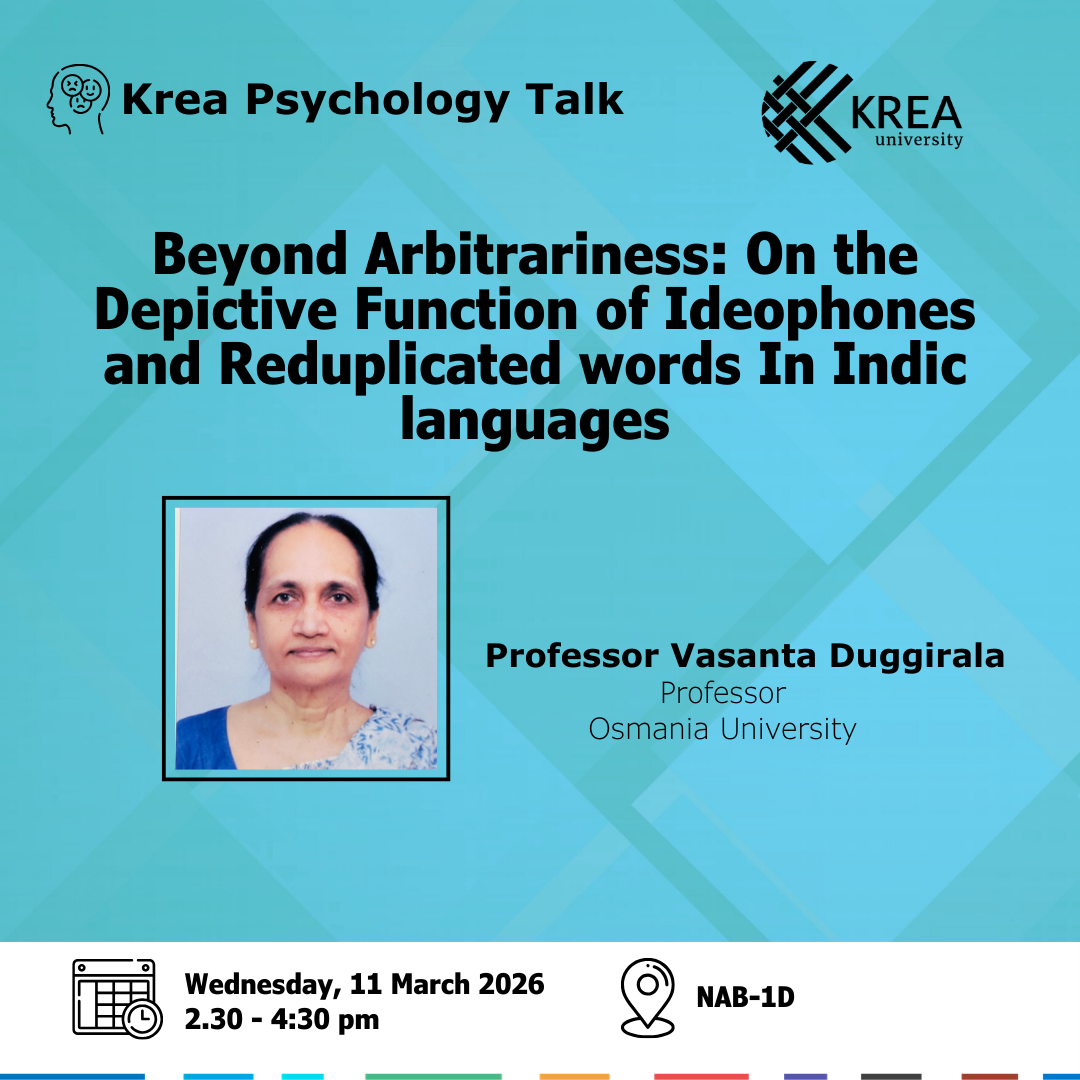
The dominant view in theoretical linguistics right from the late 19 th century till date has been that every form of human speech is nothing but a body of arbitrary and conventional linguistic signs. Both the structuralist theories of Ferdinand Saussure and the generative theories of Noam Chomsky were based on the arbitrariness thesis that has become a dogma in all branches of linguistics. However, the collaboration among linguists, neuroscientists, computer scientists and psychologists in the 21 st century forced a social turn in linguistics giving rise to Cognitive Linguistic (CL) research which views language as part of general cognition influenced by attention, memory and other psychological processes. Some of the CL researchers began to examine the nature of motivation in language by examining these so-called ‘picture words’ referred to as expressives in South Asia; ideophones in Africa; and mimetics in Japan. They went beyond gathering native speaker intuitions in analysing language by using semiotic frameworks that draw on the depictive and indexical functions of language in addition to the descriptive function. The languages of South Asia possess considerable number of ideophones and fully reduplicated words as well as partially reduplicated echo-words which package rich sensory and emotional experiences into single lexemes. During face-to-face conversations, speakers use these words along with bodily gestures and eye-gaze to depict (not just describe) the scenes they witnessed to their listeners. Ideophones with or without reduplication constitute the “sonic force that binds the languages of South Asia” and yet today they remained “unsung heroes of any grammar”. Without the knowledge of the iconic potential of these words, it is impossible to adequately grasp the socio-linguistic reality of our languages. In my presentation, I will explain major concepts dealing with iconicity in language using examples from English as well as my own research on Telugu. I will focus on issues such as sensory typologies of ideophones and reduplicated words; language-specificity; and methods of measuring iconicity. In the interactive session following my presentation, some exercises will be given to the participants who will be required to apply the concepts discussed in the lecture to iconic words from their own languages.
|
|
|
Vasanta Duggirala (born March 25, 1955) is a retired Indian linguist and speech-language pathologist based in Secunderabad, Telangana. She holds BSc and MSc degrees in Speech and Hearing from Mysore University (1971–1976) and a PhD in Audiology from the University of Memphis (1981–1986). Following early clinical work at Osmania University (1978–1981), she joined the Department of Linguistics at O.U. Hyderabad, where she advanced from Assistant Professor to full Professor (1987–2015). Her research spans phonological systems of Telugu deaf children, linguistic awareness, spatial semantics, and psycho-neurolinguistics—supported by multiple UGC grants and a DST-funded cognitive science initiative. She also developed an online postgraduate course in Psycho-neurolinguistics for UGC-INFLIBNET. Post-retirement, she continues scholarly engagement, notably with UGC-funded research on Telugu ideophones. Her publications include edited volumes, research articles, and English-to-Telugu literary translations with publishers such as HarperCollins, Navayana, and Tulika.
|
|
|
Admin office: 196, T.T.K. Road, Alwarpet, Chennai - 600018
Campus: 5655, Central ExpressWay, Sri City, Andhra Pradesh - 517464
www.krea.edu.in
|
|
|
|